
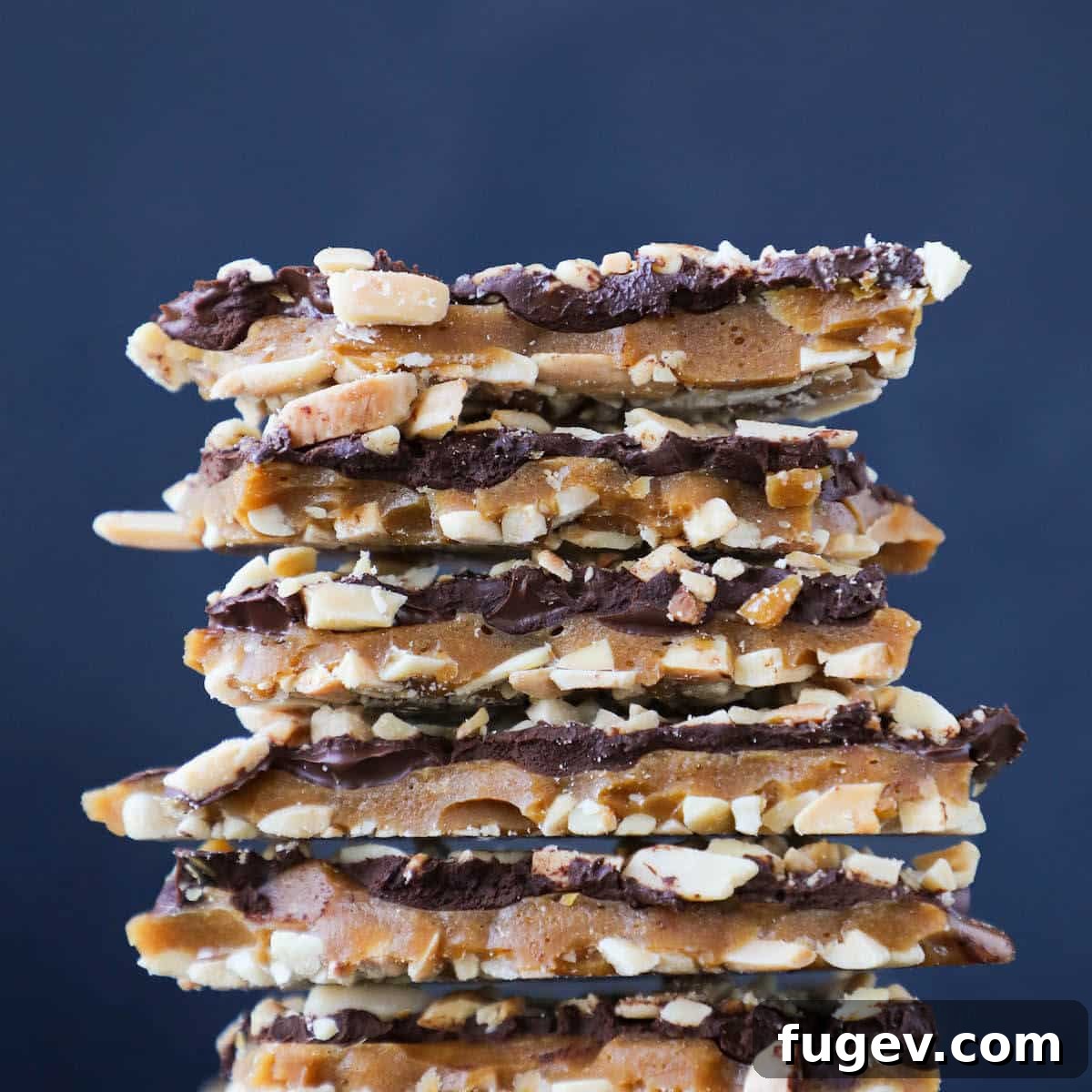
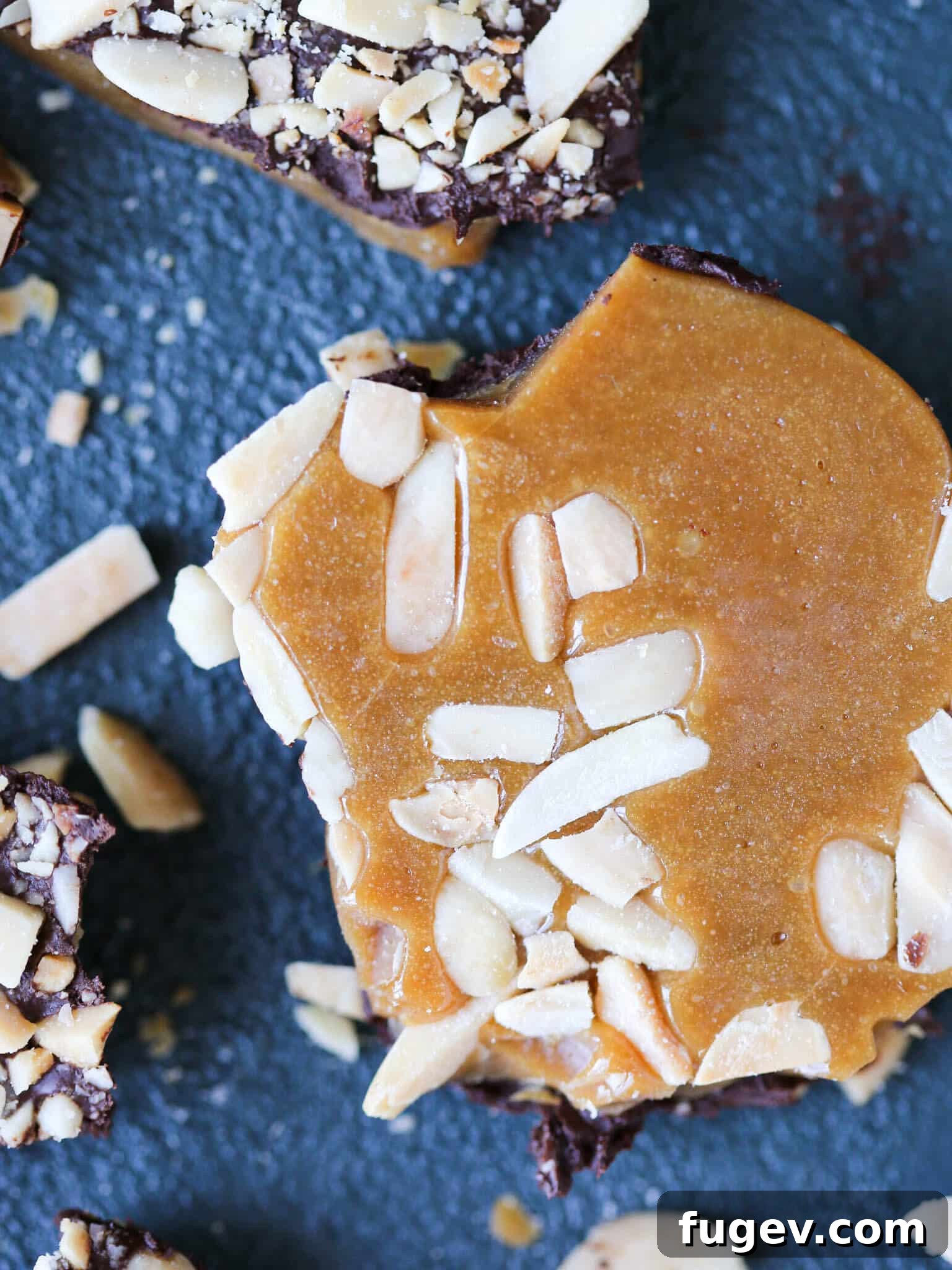
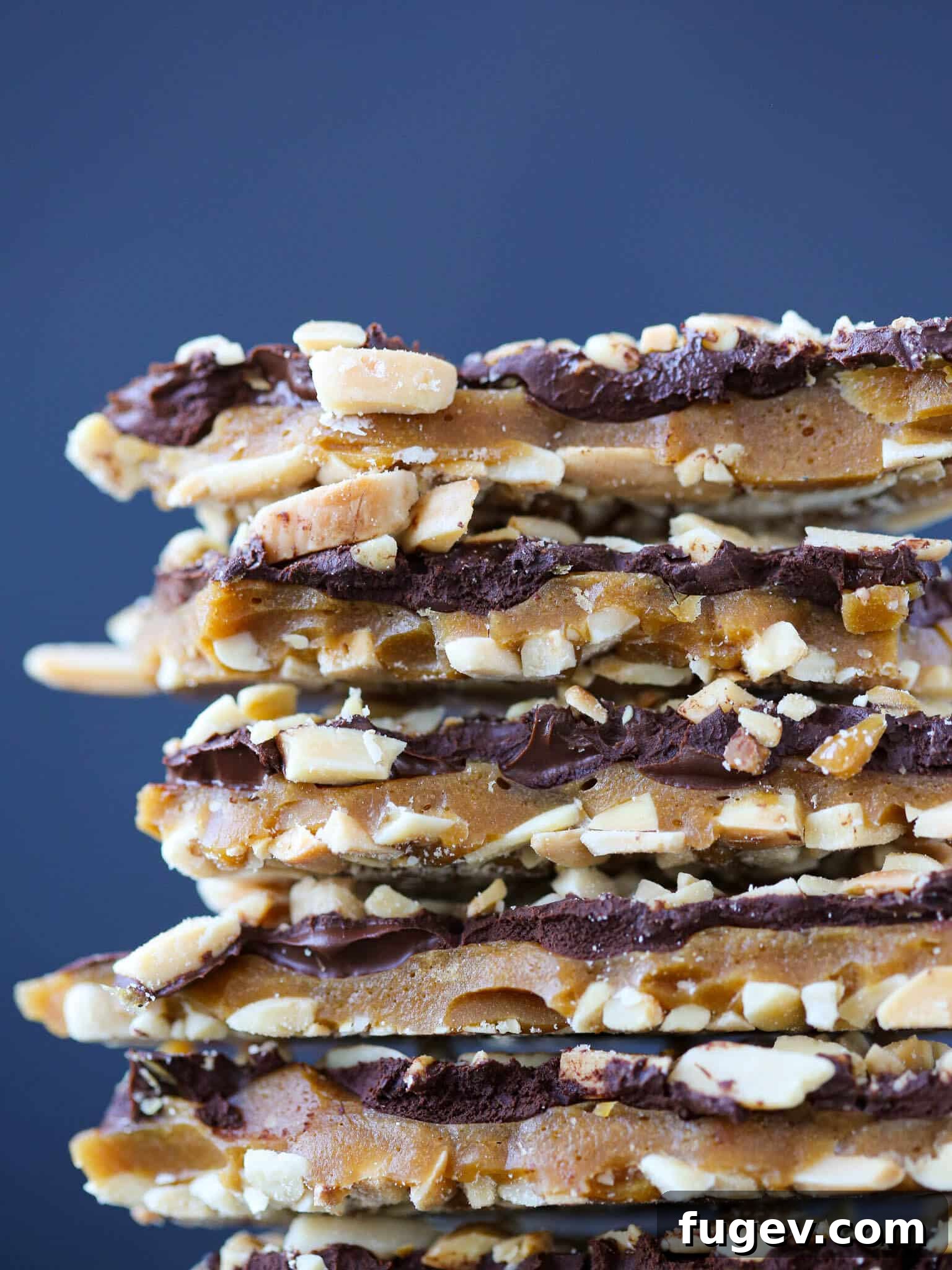
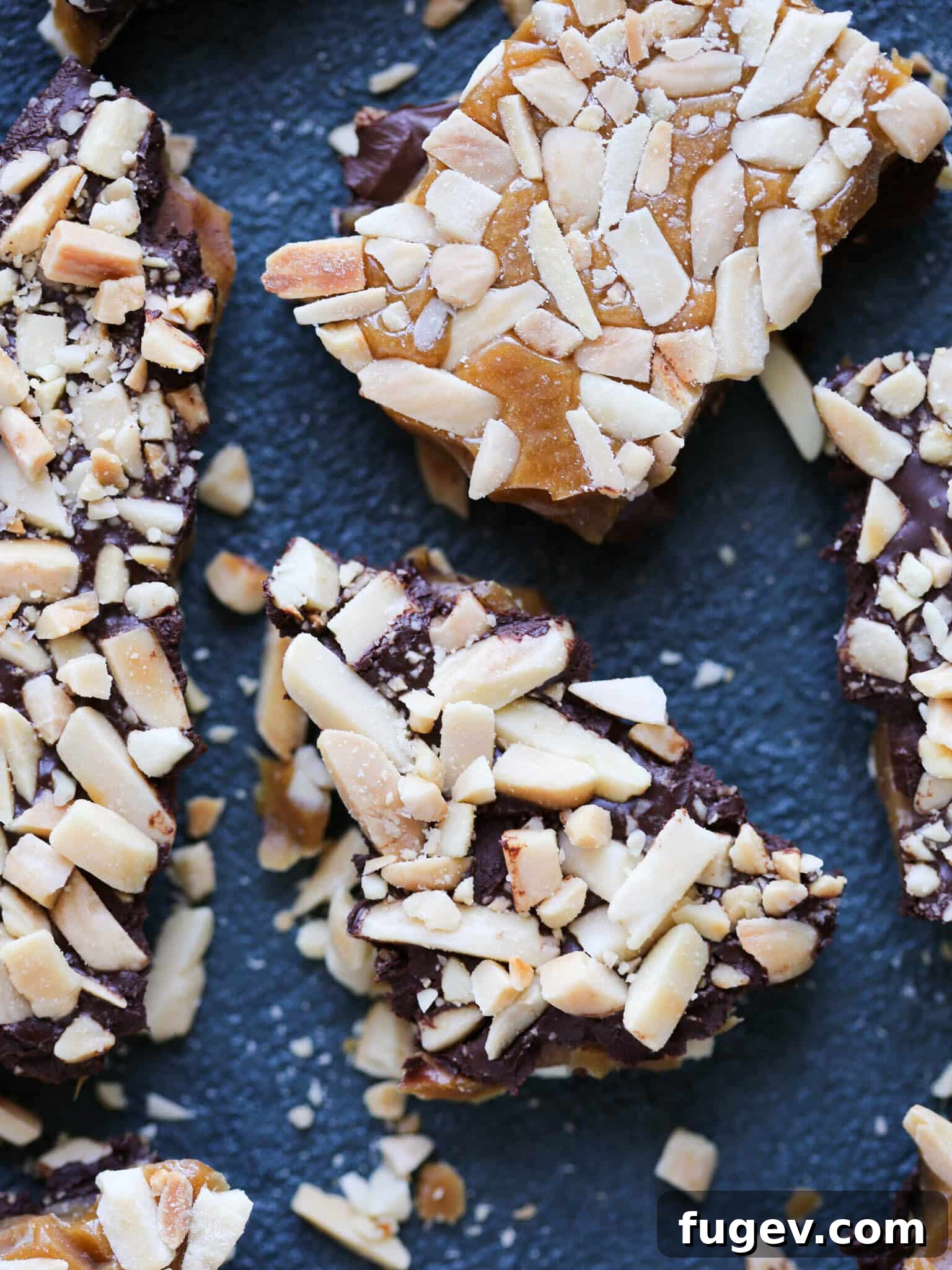
Embark on a delightful culinary journey to master the art of candy making with this incredible recipe for homemade toffee. Crafted by a professional pastry chef, this tutorial promises to guide you through creating thin, intensely crunchy, and wonderfully flavorful toffee in under 30 minutes! Imagine layers of perfectly toasted almonds, a buttery, crisp toffee, and a luxurious blanket of bittersweet chocolate – a combination that’s truly irresistible. This elegant confection is not just a delicious treat; it’s the perfect gourmet gift or a stunning addition to any holiday table, guaranteed to impress friends and family alike.
A Quick Look At The Recipe
This is a brief summary of the recipe. Jump to the detailed recipe below for full instructions.
Jump to Recipe
Prep Time
20 minutes
Cook Time
20 minutes
Total Time
40 minutes
Servings
20 pieces
Difficulty
Moderate (easy steps)
Calories *
154 kcal per serving
Technique
Make toffee, pour over nuts, top with chocolate.
Flavor Profile
Crunchy butterscotch-like candy covered in chocolate.
* Based on nutrition panel
Summarize & Save this content for later
I can’t get enough of hazelnuts and chocolate, so I made this toffee with toasted hazelnuts, and it was such a great treat! I was making it to serve with Nutella pudding. I will have to make another batch haha. I’m so glad I checked my candy thermometer, turns out it was 10 points below! Could have been a disaster. ⭐⭐⭐⭐⭐
Mara
For many, the thought of making candy at home can seem intimidating, conjuring images of burnt sugar and sticky disasters. However, with the right guidance, making delicious homemade toffee is far simpler than you might imagine. This detailed tutorial, designed to demystify the process, will show you how to create perfect toffee that is thin, crisp, and never sticky. Unlike more complex confections such as Chocolate Bourbon Truffles, this toffee recipe comes together remarkably quickly, often in less than 30 minutes of active cooking time. The secret to success in candy-making, whether it’s this toffee, Old Fashioned Chocolate Fudge, or Pecan Pralines, lies in meticulous preparation: having all your ingredients measured and readily accessible near the stovetop, and most importantly, possessing a reliable candy thermometer. This essential tool will be your best friend in achieving that coveted “soft crack stage” critical for perfect toffee texture.
What sets a truly exceptional toffee apart? Beyond the rich, buttery flavor, it’s the texture – that satisfying snap when you break off a piece, followed by a delightful crunch. Our recipe achieves this through the clever inclusion of a touch of baking soda, which reacts with the natural acids in brown sugar to create a lighter, more delicate, and significantly less sticky candy. This crunchy, nutty confection is incredibly versatile and pairs beautifully with a variety of other baked goods. Consider serving it alongside elegant Cardamom Crescents, festive Pecan Snowball Cookies, historic Moravian Christmas Cookies, or decadent Fudgy Brownie Cookies to assemble an unforgettable holiday dessert platter. Its luxurious taste and impressive appearance make it a staple for celebrations or a simple, indulgent snack.
Table of Contents
- The Science Behind Perfect Toffee: Why It Gets Sticky
- Essential Ingredients for Homemade Toffee
- Key Equipment for Toffee Making
- Delicious Substitutions and Variations
- Frequently Asked Questions About Homemade Toffee
- Homemade Toffee Recipe Card
- Pro Tips for Toffee Success
- Before You Go!
The Science Behind Perfect Toffee: Why It Gets Sticky
Achieving that iconic crisp, snappy texture in homemade toffee is a delicate balance of science and technique. Many home cooks wonder why their toffee sometimes turns out disappointingly sticky. There are three primary culprits: insufficient cooking temperature, inadequate baking soda, or high environmental humidity.
Candy making is essentially a precise chemical process, and sugar must reach very specific temperatures to transform into different forms. For toffee, the crucial benchmark is the “soft crack stage,” which occurs at 285°F (approximately 140°C). If your sugar syrup doesn’t reach this temperature, the sugar molecules won’t fully crystallize in the way needed to form a hard, brittle candy. Instead, they remain in a slightly pliable state, resulting in a chewy, sticky consistency rather than the desired crunch.
The role of baking soda in this chocolate buttercrunch toffee is also vital. Baking soda (sodium bicarbonate) is an alkaline compound that reacts with the natural acids present in brown sugar. This reaction creates tiny carbon dioxide bubbles within the candy as it cooks. These minuscule bubbles create a lighter, more aerated texture, which contributes significantly to the toffee’s ultimate crispness and helps prevent it from becoming overly dense and sticky. If not enough baking soda is used, or if its potency has diminished (always check the freshness of your baking soda!), the chemical reaction won’t be robust enough to lighten the toffee effectively.
Lastly, environmental humidity is a silent but powerful enemy of homemade toffee. Sugar is a highly hygroscopic substance, meaning it readily absorbs moisture from the air. On a humid day, even if you meticulously follow every step and hit the perfect temperature, the finished toffee can absorb ambient moisture as it cools, leading to a sticky surface. This is why many professional pastry chefs advise against making candy on particularly damp days. If humidity is unavoidable, ensure your toffee is stored in an airtight container as soon as it’s completely cooled to minimize moisture absorption.
Essential Ingredients for Homemade Toffee
Crafting perfect homemade toffee starts with understanding each ingredient’s role. Here’s a breakdown of what you’ll need and why it matters:
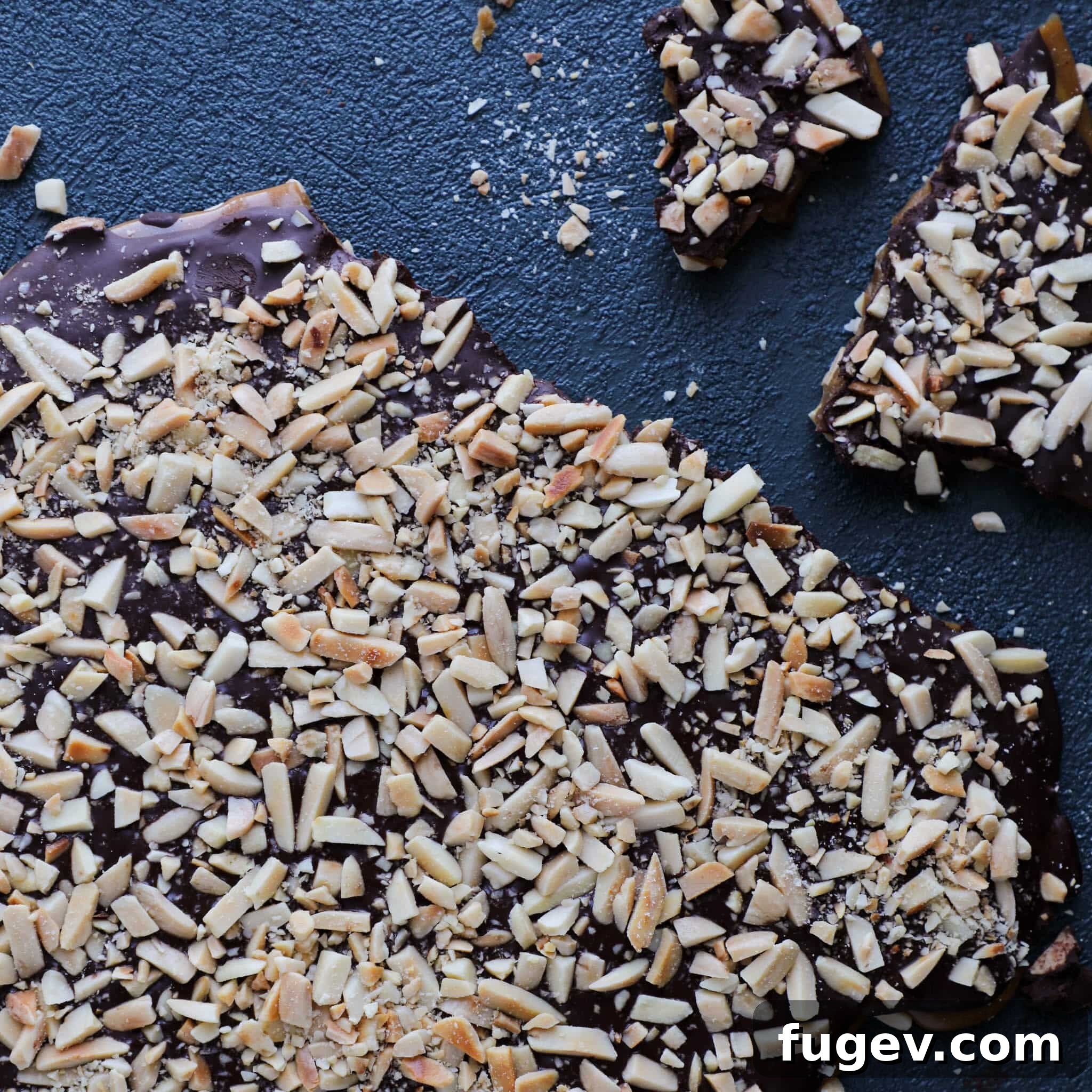
- Almonds: We recommend using blanched, slivered almonds for this recipe. Toasting the almonds before incorporating them is a crucial step; it deepens their flavor, adds a delightful nuttiness that beautifully balances the sweetness of the toffee and chocolate, and contributes an extra layer of crunch. Their delicate size also ensures even distribution throughout the candy.
- Light Brown Sugar: The foundation of our toffee’s flavor and texture. Light brown sugar brings a subtle molasses note, creating that signature butterscotch-like flavor profile. Its inherent acidity also plays a role in the baking soda’s reaction. While light brown sugar is preferred for its milder taste, dark brown sugar can be substituted for a richer, more robust flavor.
- Water: In candy making, water serves a critical purpose: it dissolves the sugar crystals, allowing for an even heating process. While tap water is perfectly fine, starting with cold water is often preferred as it promotes a slower, more controlled heating of the sugar syrup, reducing the risk of premature crystallization or scorching.
- Unsalted Butter: For baking and candy making, unsalted butter is always the preferred choice. This allows you complete control over the salt content in your final product. Butter imparts a smooth, rich quality to the toffee, contributing to its luxurious mouthfeel, much like it does in caramels, pralines, and brittles.
- Kosher Salt: A pinch of kosher salt is essential for enhancing and balancing the flavors in this sweet confection. Kosher salt is less dense and therefore less “salty” by volume than finer ground table salt, making it easier to control. It prevents the toffee from tasting bland or one-dimensional, elevating the butterscotch notes and complementing the chocolate.
- Vanilla Extract: Vanilla extract is a powerful flavor enhancer. Not only does it add its own fragrant, warm notes, but it also amplifies the inherent flavors of other ingredients, particularly the brown sugar and bittersweet chocolate, creating a more complex and harmonious taste.
- Baking Soda: As discussed, baking soda is key to achieving that perfectly light and crunchy texture. Its reaction with the acid in brown sugar creates tiny air bubbles, preventing the toffee from becoming too dense or sticky. Always check the freshness of your baking soda; an old, inactive batch won’t yield the desired results. A simple test: mix a small amount with vinegar; if it fizzes, it’s still good!
- Bittersweet Chocolate: The final layer of indulgence. Bittersweet chocolate is our top recommendation because its deep, slightly bitter notes perfectly contrast and balance the sweetness of the toffee. This creates a more sophisticated and less cloying treat. As you gain confidence in making homemade toffee, feel free to experiment with different types of chocolate to find your ideal flavor combination – it’s a wonderful way to personalize this recipe, making it one of the great gifts for home cooks.
Key Equipment for Toffee Making
While the ingredients are important, having the right tools makes all the difference in candy making. Here’s what you’ll need to ensure your toffee-making process is smooth and successful:
- Heavy-Bottomed Saucepot: A sturdy, heavy-bottomed pot is crucial. It distributes heat more evenly, preventing hot spots that can scorch your sugar mixture. This control is vital for achieving the correct temperature without burning the toffee.
- Candy Thermometer: This is arguably the most essential piece of equipment. An accurate candy thermometer is non-negotiable for success. It allows you to precisely monitor the sugar syrup’s temperature, ensuring it reaches the exact 285°F soft crack stage. Without it, you’re guessing, and guesswork in candy making often leads to sticky or overly brittle results. We highly recommend one that clips securely to the side of your pot for continuous monitoring.
- Parchment Paper or Waxed Paper: Essential for lining your baking sheet. This ensures the hot toffee doesn’t stick and makes for easy removal and clean-up. Do not skip this step!
- Baking Sheet: A standard baking sheet (approx. 9×13 inches) provides the surface for cooling your toffee. Ensure it’s large enough to spread the toffee thinly.
- Offset Metal Spatula: This tool is perfect for spreading the melted chocolate smoothly and evenly over the hot toffee, ensuring a beautiful, consistent layer.
- Measuring Cups and Spoons: Accuracy is key in candy making. Ensure all ingredients are precisely measured before you begin.
- Wooden Spoon or Heat-Resistant Spatula: For stirring the sugar mixture. A sturdy, heat-resistant utensil is important as the mixture gets very hot.
Thermometer Calibration Tip: Before you start, always test your candy thermometer for accuracy. Place it in a pot of vigorously boiling water. It should read exactly 212°F (100°C) at sea level. If it reads differently, note the difference and adjust your target temperature accordingly. For example, if it reads 210°F, you’ll know to cook your toffee to 283°F instead of 285°F.
Delicious Substitutions and Variations
While our classic homemade toffee recipe is phenomenal on its own, one of the joys of cooking is the ability to customize and experiment. Here are some delightful substitutions and variations to make this toffee truly your own:
- Nuts: While almonds are traditional, feel free to explore other nuts. Toasted walnuts offer a classic, earthy flavor, while toasted pecans provide a buttery, rich alternative. As our reviewer Mara mentioned, hazelnuts are a phenomenal pairing, especially if you love chocolate-hazelnut combinations, reminiscent of our popular Nutella Truffles. Macadamia nuts would also add a luxurious, creamy crunch. Always toast your chosen nuts for maximum flavor.
- Chocolate: We adore bittersweet chocolate for its ability to cut through the sweetness of the toffee, creating a perfectly balanced bite. However, if you prefer a sweeter treat, semi-sweet chocolate is an excellent alternative that still offers a rich chocolate flavor. We advise against using unsweetened chocolate, as its bitterness can be overwhelming even when paired with sweet toffee. Milk chocolate could be used for a very sweet, creamy topping, though it might make the overall treat quite rich.
- Dark Brown Sugar: Our recipe calls for light brown sugar, which imparts a subtle butterscotch note. For a deeper, more intense caramel flavor, reminiscent of our Sticky Toffee Pudding, you can substitute dark brown sugar. This will give the toffee a slightly darker color and a more robust, molasses-rich taste.
- Dried Fruits: Introducing dried fruits can add a wonderful chewy texture and burst of flavor to your toffee. If you’re considering how to make homemade toffee with dried fruits, here’s a pro tip: sprinkle ½ to 1 cup of finely chopped dried fruit (such as cranberries, cherries, or apricots) along with half of the almonds on your baking sheet BEFORE pouring the hot toffee mixture over the top. The heat from the toffee will gently soften the fruit and allow it to incorporate beautifully into the candy, rather than just sitting on top.
- Spices: For an extra layer of warmth, consider adding a pinch of ground cinnamon, nutmeg, or even a tiny amount of cayenne pepper to the toffee mixture along with the salt. These spices can elevate the flavor profile, making it even more unique.
- Flaked Sea Salt: After spreading the chocolate and before sprinkling the remaining nuts, a delicate sprinkle of flaked sea salt can enhance the chocolate’s flavor and add a sophisticated touch, creating a delightful sweet-and-salty contrast.
Frequently Asked Questions About Homemade Toffee
Once completely cooled and broken into pieces, homemade toffee should be stored in an airtight container at room temperature. This protects it from moisture and keeps it fresh.
When stored properly in an airtight container at room temperature, homemade toffee will maintain its ideal crunch and flavor for up to a month. After this period, you might notice it beginning to crystallize slightly, becoming a bit softer, but it will still be delicious and perfectly safe to eat.
While technically possible, we generally advise against freezing toffee. When thawed, toffee tends to absorb moisture from the air, causing it to lose its signature crunchy texture and become soft or sticky. For best results, enjoy it fresh or store it at room temperature as recommended.
Yes, you can absolutely double or even triple this toffee recipe to make a larger batch, which is perfect for holiday gifting or entertaining. However, ensure that your saucepot is large enough to safely contain the increased volume of sugar syrup, as it will boil and expand. A larger batch will also take longer to reach the correct temperature, so be patient and continuously monitor your candy thermometer. You can easily divide the hot toffee amongst multiple parchment-lined baking sheets if one isn’t sufficient for spreading.
If your toffee is soft or chewy, it likely didn’t reach the full 285°F (soft crack stage) on your candy thermometer. This means there was too much moisture left in the sugar mixture. Always ensure your thermometer is calibrated and accurately reflects the temperature.
To prevent chocolate from seizing (becoming thick and grainy), ensure no water or steam comes into contact with it during melting. Chop your chocolate finely to help it melt more evenly and quickly when sprinkled over the hot toffee.
If you tried this recipe and loved it please leave a 🌟 star rating and let me know how it goes in the comments below. I love hearing from you; your comments make my day!
Homemade Toffee
Chef Lindsey
20 mins
20 mins
40 mins
20 pieces
Pin Recipe
Comment
Print Recipe
Ingredients
- 2 cups blanched sliced almonds
- 1 ¼ cups light brown sugar firmly packed
- 2 tablespoons water
- ½ cup unsalted butter
- ¼ teaspoon kosher salt
- 1 teaspoon vanilla extract
- ¼ teaspoon baking soda
- 6 oz bittersweet chocolate chopped
Instructions
-
Preheat your oven to 350°F (175°C). Spread the blanched, slivered almonds evenly on a baking sheet. Toast them in the preheated oven for 5-7 minutes, stirring occasionally, until they turn a beautiful light golden brown and become fragrant. Watch them carefully to prevent burning. Remove from oven and cool completely.
-
Once cooled, chop the toasted almonds. You can do this by hand with a sharp knife or pulse them briefly in a food processor. The goal is fine crumbs, but avoid turning them into a powder; you want delightful, uneven bits for texture.
-
Prepare a separate cookie sheet by lining it with parchment paper or waxed paper. Evenly sprinkle half of your chopped toasted almonds onto the lined sheet. Try to confine them to a rough 7-inch by 10-inch rectangle to guide the shape of your toffee. Set this aside near your stovetop.
-
Mise en Place is Key: Before you begin cooking, ensure all your remaining ingredients (brown sugar, water, butter, salt, vanilla extract, baking soda, and chopped chocolate) are precisely measured out and within arm’s reach of your stovetop. Candy making moves quickly, and you won’t have time to measure once the sugar starts cooking.
-
In a medium, heavy-bottomed saucepot, combine the light brown sugar, water, unsalted butter, and kosher salt. Stir these ingredients together until well combined. Place the pot over medium heat and bring the mixture to a rolling boil, stirring constantly to prevent the sugar from sticking and burning to the bottom of the pot.
-
Once boiling, reduce stirring to occasional intervals but keep a close eye on your candy thermometer. Continue to boil the mixture until it reaches precisely 285°F (140°C), which is the “soft crack stage.” This stage is crucial for the toffee’s crisp texture. Immediately remove the saucepot from the heat. Carefully remove the thermometer. Stir in the vanilla extract and baking soda quickly and vigorously. The mixture will bubble and lighten in color.
-
Without delay, pour the hot candy mixture evenly over the almonds prepared on the baking sheet. Use a heat-resistant spatula to gently spread it if necessary, but work quickly as it sets fast. Immediately scatter the chopped bittersweet chocolate evenly over the hot toffee. Let it sit undisturbed for about 5 minutes; the residual heat from the toffee will melt the chocolate. Once melted, use an offset metal spatula to spread the chocolate smoothly and evenly over the toffee surface. Finally, sprinkle the remaining half of the chopped almonds over the melted chocolate.
-
Allow the toffee to cool completely at room temperature. This can take 1-2 hours. Do not try to rush the cooling process by placing it in the refrigerator, as this can affect the texture and potentially cause stickiness due to condensation. Once completely firm and cool, break the toffee into irregular pieces using your hands or a sharp knife. Store as directed.
Pro Tips for Toffee Success
Let’s get into it like a PROFESSIONAL CHEF:
Presentation – To achieve a visually appealing toffee with delightful, uneven bits of almond, be sure not to grind your toasted almonds too finely. Also, when sprinkling the first half of the almonds, try to keep them somewhat contained within the general dimensions you intend your toffee to be, helping define its final shape.
Flavor Tips – As highlighted in our ingredient section, bittersweet chocolate truly shines here, cutting through the sweetness for a balanced bite. If you prefer a more indulgent, sweeter profile, semi-sweet chocolate is a fantastic alternative. However, we found unsweetened chocolate to be too starkly bitter, even with the sweet toffee base. Experiment with different chocolate brands and cocoa percentages to find your favorite!
Technique – The core of perfect toffee lies in precision. Reaching the “soft crack stage” (285°F/140°C) is non-negotiable for that satisfying crunch. The baking soda is not just for leavening; it reacts with brown sugar’s acidity, creating a lighter, less sticky texture. Remember, sugar is hygroscopic – it loves moisture. Making toffee on a very humid day, even with perfect technique, risks a sticky finish. Choose a dry day if possible!
Helpful Tools – A quality candy thermometer is mission-critical. I prefer one that clips securely to the side of the pot for constant temperature monitoring, allowing you to react instantly. Always calibrate your thermometer before use by placing it in boiling water (should read 212°F/100°C) to ensure accuracy and prevent recipe disasters.
Variations – Don’t limit yourself to almonds! Toasted hazelnuts offer a phenomenal flavor pairing (especially with chocolate!), as would toasted walnuts or pecans. For a unique twist, incorporate dried fruits like cranberries or chopped apricots. Sprinkle ½ -1 cup of dried fruit along with your nuts on the baking sheet before pouring the toffee; the heat will soften them beautifully into the candy.
Storage – Store your cooled, broken toffee in an airtight container at room temperature. It will retain its crispness and flavor for about a month. Beyond that, it might begin to crystallize, becoming a bit chewier, but it remains delicious. Freezing is generally not recommended as thawing can introduce moisture, causing the toffee to lose its desired crunchy texture.
Recipe adapted from Rose’s Christmas Cookies, by Rose Levy Beranbaum. 1990 Edition.
Yield: Approximately 1 pound of toffee.
Nutrition
Carbohydrates: 7g |
Protein: 3g |
Fat: 14g |
Saturated Fat: 5g |
Polyunsaturated Fat: 2g |
Monounsaturated Fat: 6g |
Trans Fat: 0.2g |
Cholesterol: 13mg |
Sodium: 46mg |
Potassium: 121mg |
Fiber: 2g |
Sugar: 4g |
Vitamin A: 147IU |
Calcium: 32mg |
Iron: 1mg
Like this? Leave a comment below!
Before You Go!
We hope this comprehensive guide inspires you to create delectable homemade toffee that rivals any gourmet confectionary. The satisfaction of crafting such a delightful treat from scratch is truly rewarding. But don’t let your candy-making adventures end here!
Explore our other delicious, chef-developed candy recipes for more sweet inspiration, from rich fudges to intricate truffles. And if you’re planning for the holiday season or simply love to bake, you might also want to discover some easy Christmas cookies that pair wonderfully with homemade toffee, or choose a few traditional Christmas cookies to round out your festive baking repertoire. Happy baking and sweet treating!