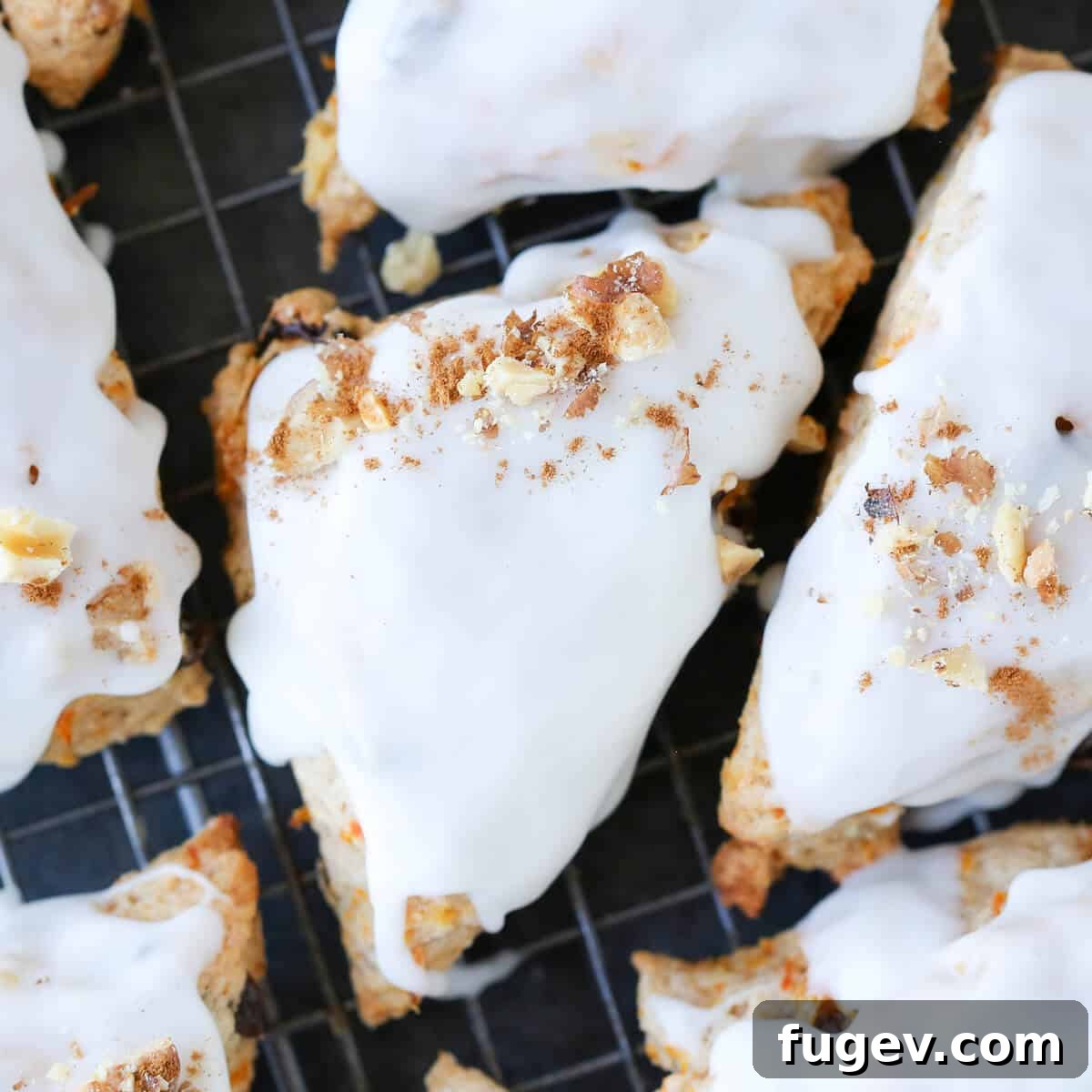
Irresistible Carrot Cake Scones with Luxurious Cream Cheese Glaze
Indulge in these magnificent carrot cake scones, perfectly crafted to deliver that tender, melt-in-your-mouth scone texture infused with all the beloved flavors of classic carrot cake, beautifully crowned with a luscious cream cheese glaze. Prepare to elevate your breakfast or brunch experience!

These carrot cake scones are truly the complete package, offering a harmonious blend of textures and tastes. Imagine a perfectly tender and moist scone, generously studded with vibrant shredded carrots, satisfyingly crunchy walnuts, and naturally sweet raisins. Each scone is then elegantly finished with a thick, tangy, and sweet cream cheese glaze, reminiscent of your favorite carrot cake frosting. The subtle crunch from the toasted walnuts and the bursts of sweetness from the raisins create a delightful contrast, making every bite an unforgettable experience. This recipe isn’t just about baking scones; it’s about crafting a moment of pure culinary bliss.
Continuing the tradition of my signature “never-cakey” scone experience, these carrot cake delights join their esteemed companions like my popular chocolate chip scones and refreshing blueberry scones. They are designed to perfectly satisfy your craving for something truly indulgent, yet wonderfully appropriate for breakfast or a leisurely afternoon tea. And for those who develop an irresistible fondness for the glorious cream cheese frosting (which I can only imagine you will!), you can extend your culinary adventure by pairing it with my stunning red velvet cookies for a truly decadent dessert later in the day.
Table of Contents
- Why You Will Love This Carrot Cake Scones Recipe
- Professional Baking Tips for Perfect Scones
- Key Ingredients and Their Roles
- Common Scone Making Mistakes and How to Avoid Them
- Creative Variations for Your Carrot Cake Scones
- How to Serve Your Carrot Cake Scones
- Step-by-Step Guide: How to Make Carrot Cake Scones
- Chef Lindsey’s Exclusive Recipe Tip
- Frequently Asked Questions About Carrot Cake Scones
- Carrot Cake Scones Recipe Card
- Before You Go
Why You Will Love This Carrot Cake Scones Recipe:
- Unrivaled Carrot Flavor: These scones are truly bursting with fresh carrot goodness! I’ve packed even more shredded carrots into this recipe than in my beloved carrot cake cupcakes, ensuring an incredibly vibrant and authentic carrot cake experience in every bite.
- Perfectly Balanced Cream Cheese Glaze: The accompanying cream cheese glaze is simply divine – tangy, lightly sweet, and incredibly easy to whip up. It perfectly complements the spiced scones without overpowering them. This makes these scones versatile enough for an elegant Easter brunch, a comforting everyday breakfast, or a special dessert.
- Effortless Professional-Level Baking: Don’t let the idea of homemade scones intimidate you! I’ve meticulously broken down every step and shared my professional chef secrets. With my guidance, you’ll be creating tender, flaky scones with the ease and confidence of a seasoned baker, impressing everyone who tries them.
- The Ideal Texture You Crave: Say goodbye to dry, dense, or crumbly scones. My unique technique ensures a consistently tender and moist crumb, a true testament to perfectly executed scone baking. You’ll achieve that sought-after delicate texture that makes scones so irresistible.
- Seasonal Versatility: While perfect for spring and holiday tables, the comforting spices and hearty ingredients make these carrot cake scones a delightful treat year-round. They are a wonderful way to enjoy the classic flavors of carrot cake in a new, exciting format.

Professional Baking Tips for Perfect Scones
Achieving bakery-quality scones at home is entirely possible with a few key techniques. Here are my top professional tips to ensure your carrot cake scones are tender, moist, and absolutely delicious every single time:
- Completely Incorporate the Cold Butter into Dry Ingredients: This might contradict conventional wisdom for some scone recipes, which often suggest leaving pea-sized butter chunks. However, through years of rigorous testing in professional kitchens and making countless giant batches, I’ve found that fully cutting the butter into the dry ingredients creates the most incredibly tender and moist scones. When butter is completely distributed, it coats the flour particles more evenly. This means you’ll need less liquid to bring the dough together, which in turn leads to less gluten development. The result? No tough, dry, or sad scones here – just perfectly delicate and flaky baked goods that practically melt in your mouth.
- Shred and Thoroughly Squeeze Your Own Carrots: This step is critical for preventing gummy pockets in your finished scones. Pre-shredded carrots from the store often contain excess moisture and can lead to a heavy, dense texture. By freshly grating and vigorously squeezing out the liquid from your carrots, you ensure that the moisture content in your dough is precisely controlled. This technique is also a secret weapon I use for my renowned best carrot cake recipe, guaranteeing a light crumb every time. Use a clean kitchen towel or paper towels to press out as much liquid as possible.
- Whisk All Wet Ingredients Together Until Uniform: Before adding any liquid to your dry mixture, ensure all your wet ingredients—vanilla, eggs, and heavy cream—are thoroughly whisked together until smooth and pale, with no visible streaks of egg yolk or cream. In large-scale production, I’d use an immersion blender for this, but a simple hand whisk works perfectly for home baking. The advantage of pre-mixing is that the eggs are fully incorporated before they even touch the flour. This minimizes the amount of mixing required once the wet ingredients are added to the dry, which is paramount for preventing over-development of gluten. Less mixing equals more tender, delicate baked goods – a fundamental rule for perfect scones!
Key Ingredients and Their Roles in Perfect Carrot Cake Scones
Understanding the function of each ingredient is key to successful baking. Here’s a breakdown of what makes these carrot cake scones so delicious:
- All-Purpose Flour: My preferred choice is all-purpose flour, which contains just the right amount of gluten. This ensures your scones develop a beautiful, flaky texture without becoming overly tough or chewy. It provides the essential structure while maintaining a delicate crumb.
- Baking Powder: We use double-acting baking powder, which is crucial for lift. It reacts twice: first when mixed with a liquid acid, and then again when exposed to heat in the oven. This dual action provides a more stable and sustained rise compared to baking soda alone, contributing to those desirable tall, fluffy scones. It also gives you the flexibility to prepare the dough ahead of time and freeze it.
- Cinnamon: A warm, aromatic spice that is foundational to classic carrot cake flavor, enhancing the sweetness and complexity of the scones.
- Kosher Salt: More than just for seasoning, kosher salt balances the sweetness, amplifies the other flavors, and plays a role in gluten development, contributing to the overall texture.
- Granulated Sugar: Granulated sugar contributes more than just sweetness. It tenderizes the dough, helps retain moisture, and improves the overall texture and stability of the scones, ensuring they don’t dry out too quickly.
- Light Brown Sugar: Adding light brown sugar introduces a subtle molasses flavor and additional moisture, contributing to a richer taste and an even softer, chewier texture compared to using only granulated sugar.
- Unsalted Butter: I always opt for unsalted butter in baking to precisely control the salt content. Butter is absolutely integral in scone making. As it’s cut into the flour and melts during baking, it creates steam, which is responsible for those wonderful flaky layers. More importantly, butter shortens gluten strands by coating them during mixing, preventing them from forming a strong, elastic network that would lead to tough scones.
- Whole Eggs: Large eggs provide essential fat, moisture, and a degree of leavening. The fat from the yolks enriches the flavor and helps keep the scones beautifully moist. As one of the primary liquid ingredients, eggs bind the dough without over-developing the gluten, ensuring a tender result.
- Heavy Cream: Heavy cream is crucial for providing sufficient liquid to achieve a moist, tender crumb, while its high fat content adds richness and contributes significantly to both flavor and texture. Along with the eggs, it provides the essential moisture needed to form the dough.
- Grated Carrots: Use freshly peeled, grated, and thoroughly squeezed medium carrots. If you can find them, “horse carrots” (often sold loose at grocery stores) are excellent—they tend to be larger, juicier, and more flavorful than the slender, bagged varieties. A box grater or food processor ensures an even shred size, which is important for even distribution and baking.
- Walnuts: While optional, walnuts add a delightful crunch and nutty depth. I highly recommend lightly toasting them first to truly bring out their maximum flavor and aroma.
- Raisins: These provide natural sweetness and a chewy texture that complements the carrots and spices beautifully. Use good quality raisins.
- Cream Cheese: For the ultimate glaze, I always use original Philadelphia Cream Cheese. Its characteristic tanginess is key to that authentic carrot cake flavor profile, whether in buttercreams or glazes. Full-fat cream cheese is recommended for the best flavor and consistency, though reduced-fat can be substituted if absolutely necessary.
- Confectioners’ Sugar: Confectioners’ sugar (also known as powdered sugar) is finely milled, allowing it to dissolve quickly and create a perfectly smooth, lump-free glaze without needing heat.
- Milk: A small amount of milk helps to adjust the consistency of the cream cheese glaze, ensuring it’s pourable yet thick enough to coat the scones beautifully.
- Vanilla Extract: Vanilla extract rounds out the flavors, adding a comforting warmth and depth to both the scones and the glaze.
For precise measurements and quantities, please refer to the complete recipe card below!
Common Scone Making Mistakes and How to Avoid Them
Making delicious, tender scones is a straightforward process, but there are a couple of common pitfalls that can lead to less-than-perfect results. Understanding and avoiding these mistakes will ensure your carrot cake scones are consistently amazing:
- Overmixing the Dough: This is unequivocally the biggest mistake home bakers make when creating scones. Overmixing rapidly develops the gluten in the flour, which is desirable for breads but disastrous for scones. Excessive gluten leads to a tough, chewy, and dense texture instead of the desired tender, flaky crumb. To avoid this, mix the dough just until the ingredients are combined and no dry streaks of flour remain. A shaggy dough is a good dough! Using a stand mixer for initial mixing (as per my tip) and then finishing by hand gives you the best control.
- Not Keeping Ingredients Cold (Especially Butter): Cold ingredients, particularly butter, are fundamental to flaky scones. When cold butter hits the hot oven, the moisture in the butter rapidly turns to steam, creating pockets of air and pushing apart the layers of dough. If your butter is too warm, it will simply melt into the dough before baking, resulting in flat, dense scones. Always start with very cold butter and don’t skip the chilling step!
- Skipping the Chill Time Before Baking: This step is not optional! Refrigerating the shaped scone dough for at least 30 minutes (or even 1-2 hours) before baking serves multiple purposes. First, it re-chills the butter, solidifying it so it can properly create steam in the oven. Second, it allows the gluten to relax, further contributing to a tender texture. Lastly, it helps the scones maintain their shape and bake up tall and proud, rather than spreading out into flat disks. Cold dough equals tall, flaky scones!
- Using Too Much Flour on Your Work Surface: When kneading or shaping your dough, resist the urge to heavily flour your countertop. Too much added flour can dry out your dough, altering the delicate balance of ingredients and leading to tough scones. Use just enough flour to prevent sticking, or work on a lightly oiled or even dry surface as recommended in my instructions.
- Over-handling the Dough: Similar to overmixing, excessive handling or aggressive kneading can warm the butter and develop gluten. Treat your scone dough gently, using light hands and minimal pressure when bringing it together or shaping.
Creative Variations for Your Carrot Cake Scones
While this classic carrot cake scone recipe is perfect as is, it also serves as a fantastic canvas for creative adaptations. Feel free to experiment and make them uniquely your own!
- Experiment with Diverse Mix-Ins: The beauty of scones lies in their adaptability to various additions. While walnuts and raisins are traditional, you can easily omit them if preferred, or substitute them with other dried fruits or nuts. Pecans, for example, would be an absolutely perfect alternative, offering a slightly different nutty profile. Consider adding dried cranberries for a tart counterpoint, or even a hint of crushed pineapple, much like I do in my vibrant hummingbird cake, for a tropical twist and extra moisture. Finely chopped dried apricots or dates would also be wonderful.
- Introduce Different Spices for Enhanced Warmth: Cinnamon is a must, but a medley of spices can elevate the “cake” aspect of these scones. For extra warmth and complexity, try adding a quarter or half teaspoon of ground cloves, a full teaspoon of freshly ground nutmeg for its distinctive aroma, or a teaspoon of ground ginger for a gentle spicy kick. You could also lean into seasonal spice blends, incorporating a touch of my homemade apple pie spice or my cozy pumpkin spice mix recipe, similar to how I sometimes flavor my easy carrot cake recipe.
- Craft a Distinctive Glaze: The cream cheese glaze is iconic, but you can certainly customize it. For a warmer flavor profile, whisk a pinch of extra cinnamon directly into your cream cheese glaze, drawing inspiration from my delightful cinnamon scones. If you’re feeling adventurous and want an adult twist, consider creating a sophisticated bourbon glaze using the simple syrup technique from my indulgent carrot cake roll – it adds a fantastic depth of flavor that pairs wonderfully with carrot cake spices. A simple lemon zest addition to the cream cheese glaze could also offer a bright, citrusy note.
How to Serve Your Carrot Cake Scones
These carrot cake scones are incredibly versatile and perfect for a variety of occasions. Here are some delightful ways to serve them:
- Classic Morning Treat: These scones pair absolutely beautifully with a freshly brewed cup of coffee, a robust espresso, or a comforting mug of tea. They are the quintessential morning indulgence that feels both special and satisfying.
- Elegant Brunch Addition: Elevate any brunch spread by featuring these scones. Their vibrant flavor and appealing appearance make them a centerpiece, especially alongside fresh fruit, yogurt parfaits, or a savory quiche.
- Enhanced Texture with Toasted Nuts: For an extra layer of crunch and visual appeal, sprinkle a few extra toasted chopped walnuts over the top of the scones after applying the cream cheese glaze, while it’s still wet. This adds a lovely professional touch.
- With Decadent Spreads: Serve them alongside a dollop of homemade maple butter for an added touch of sweetness, or a generous smear of softened cream cheese to amplify the “carrot cake” experience. A side of fruit preserves or lemon curd would also be a lovely accompaniment.
- Dessert Upgrade: Don’t limit these to breakfast! Warm them slightly and serve them as a rustic dessert with a scoop of vanilla bean ice cream or a drizzle of caramel sauce for a truly memorable end to a meal.
Step-by-Step Guide: How to Make Carrot Cake Scones
Follow these detailed instructions to create perfectly tender and flavorful carrot cake scones:
Further details and exact measurements for each ingredient can be found in the comprehensive recipe card below!
Part 1: Make the Scones
Step 1: Prepare Your Oven and Baking Sheet. Begin by preheating your oven to 325°F (160°C). Line a large baking sheet with parchment paper. This prevents sticking and ensures even baking.
Step 2: Combine Dry Ingredients and Butter. In a large mixing bowl, or the bowl of a stand mixer fitted with the paddle attachment, add the all-purpose flour, granulated sugar, light brown sugar, kosher salt, ground cinnamon, and baking powder. Mix these dry ingredients on low speed, or by hand with a whisk, just until they are well distributed. Next, add the cold, cubed unsalted butter. Continue mixing on low speed until the butter is completely cut into the dry ingredients. The mixture should resemble wet sand, with no visible chunks of butter remaining. This thorough incorporation of butter is key to tender scones.
Step 3: Prepare the Wet Ingredients. While the dry ingredients and butter are mixing, in a separate medium bowl, combine the vanilla extract, large eggs, and heavy cream. Use an immersion blender or a whisk to blend these ingredients until they are completely smooth and pale, with no visible streaks of egg yolk or cream. This ensures even distribution of liquids and minimizes mixing later.
Step 4: Gently Incorporate Wet into Dry Ingredients. With your stand mixer running on its lowest speed (or mixing by hand with a spatula), slowly and gradually pour the prepared cream mixture into the dry ingredients. Mix just until the wet ingredients are almost fully incorporated into the dry mixture. It’s crucial not to overmix at this stage! The dough will still look shaggy and slightly crumbly; this is exactly what you want. If you think it’s done, it probably is. Overmixing is the enemy of tender scones as it develops tough gluten.
Step 5: Lightly Knead the Dough. Gently dump the almost-combined mixture out onto a clean, dry work surface. There’s no need to heavily flour your surface, as adding too much extra flour can dry out your dough. Carefully knead the dough together by hand, using light pressure, until no visible dry spots of flour remain and the dough just comes together into a cohesive ball. This should take only a minute or two.
Step 6: Fold in Carrot Cake Add-Ins. Before adding your carrots, ensure you’ve thoroughly squeezed out as much moisture as possible from the shredded carrots. Then, add the prepared carrots, toasted walnuts (if using), and raisins (if using) to the dough. Gently fold them into the dough until they are evenly distributed. Be careful not to overwork the dough during this step.
Step 7: Shape and Chill the Scones. Lightly press the dough out onto your work surface with your hands or a rolling pin until it is about one inch thick. Using a sharp knife or a pastry cutter, cut the dough into approximately 3.5-inch wide strips. Then, cut each strip into squares, and subsequently cut each square in half diagonally to form triangular wedges. Carefully place these scone wedges onto your parchment paper-lined baking sheet, leaving a little space between each. This next step is vital: refrigerate the shaped scones for at least 30 minutes. You want them to be cold and firm to the touch before baking. If you have time, chilling them for 1–2 hours or even overnight will yield the best results, ensuring tall, flaky scones by re-chilling the butter.
Step 8: Prepare for Baking. Just before baking, gently brush the tops of your chilled scones with a little extra heavy cream. This helps create a beautiful golden crust and locks in moisture, contributing to a tender interior.
Step 9: Bake to Golden Perfection. Place the baking sheet into your preheated oven. Bake the scones on a HIGH fan setting (if your oven has one, otherwise a regular setting is fine) for 18-20 minutes for 3 1/2-inch scones, or until they are puffed up and golden brown on top and around the edges. To check for doneness, they should feel lightly firm with a little spring when you gently press the center.
Step 10: Cool Completely. Once baked, transfer the scones on their parchment paper to a wire rack to cool completely. Allowing them to cool fully is important before glazing, as a warm scone will melt the glaze.
Part 2: Make the Glaze and Assemble
Step 11: Prepare the Cream Cheese Glaze. In a medium bowl, whisk together the softened cream cheese, confectioners’ sugar, milk, and vanilla extract until the mixture is completely smooth and free of lumps. Cover the bowl with plastic wrap and set aside until you’re ready to glaze the scones.
Pro Tip: If your glaze sits for a while and thickens, just give it another good stir before using to restore its smooth, pourable consistency.
Step 12: Glaze and Enjoy! Once your scones are mostly cooled (a little residual warmth is okay, especially if you, like me, have a delightful lack of self-control around these scones!), generously drizzle or spread the freshly made cream cheese glaze over each scone. Allow the glaze a few minutes to set slightly, then serve and savor every incredible bite!
Chef Lindsey’s Exclusive Recipe Tip
For truly superior carrot cake scones, leverage the power of your stand mixer but don’t be afraid to get your hands dirty! Begin the dough creation in your mixer, cutting in the butter and bringing the liquids almost together. This initial mechanical mixing ensures optimal tenderness by efficiently breaking down the butter and gently hydrating the flour. However, when it comes to the final stages – particularly bringing the dough fully together and folding in the delicate shredded carrots, walnuts, and raisins – finish by hand. This manual approach provides unparalleled control. You can ensure that the dough is just incorporated without overmixing, preventing gluten development that leads to tough scones. It also allows you to evenly distribute the carrots and other mix-ins without overworking the dough. No uneven carrot distributions in these carrot cake scones, the horror!

Frequently Asked Questions About Carrot Cake Scones
To maintain their tender texture, store baked, unglazed scones in an airtight container at room temperature for up to 3 days. For longer storage, they will keep for up to 7 days in the refrigerator. However, for the absolute freshest taste, scones are always best enjoyed the day they are baked. My preferred method for making them ahead is to freeze the cut, unbaked dough and bake them fresh as needed. Pre-baked and frozen scones will last for up to 3 months.
The quintessential flavor of an easy carrot cake, and by extension these scones, comes from a delightful symphony of ingredients. This typically includes the natural sweetness and earthiness of freshly shredded carrots, the warm spice of cinnamon (and sometimes other spices like nutmeg or ginger), the rich crunch of toasted walnuts, and the chewy bursts of sweetness from raisins. All these elements are traditionally brought together and perfectly complemented by a tangy, sweet cream cheese glaze that truly defines the carrot cake experience.
Making these scones ahead is incredibly convenient! Simply prepare the dough as directed through Step 7 (shaping and chilling). Instead of just chilling for 30 minutes, you can wrap the unbaked, cut scones well in plastic wrap and then place them in an airtight container or freezer-safe bag. They will keep beautifully in the freezer for up to 3 months. When you’re ready to bake, simply place the frozen scones directly onto a parchment-lined baking sheet, brush with cream, and bake. The precise bake time will be slightly longer, typically around 22-25 minutes at 325°F (160°C) with convection or 350°F (175°C) in a regular oven, or until golden brown and cooked through.
Yes, some substitutions are possible, though they might alter the final texture or flavor slightly. For example, if you don’t have heavy cream, whole milk can be used, but the scones may be slightly less rich. Other nuts like pecans can replace walnuts. Dried cranberries or chopped dried apricots can replace raisins. For the glaze, full-fat cream cheese is recommended for the best consistency, but reduced-fat can work. Avoid substituting all-purpose flour for other types of flour without understanding the impact on gluten and moisture.
Flat scones are usually due to warm butter, expired baking powder, or insufficient chilling. Ensure your butter is very cold and your baking powder is fresh (check the expiration date). Most importantly, do not skip the chilling step! Cold dough helps the butter create steam, resulting in a good rise. Overworking the dough can also lead to flat scones by developing too much gluten and warming the butter.

If you tried this recipe and loved it, please leave a 🌟 star rating and let me know how it goes in the comments below. I love hearing from you; your comments truly make my day!

Carrot Cake Scones
Chef Lindsey
25 minutes
20 minutes
30 minutes
1 hour
15 minutes
12
scones
Pin Recipe
Comment
Print Recipe
Ingredients
-
4 1/3 cups all-purpose flour -
1/2 cup granulated sugar -
1/3 cup light brown sugar -
1/2 teaspoon kosher salt -
1 tablespoon cinnamon -
1 1/2 teaspoon baking powder -
13 tablespoons unsalted butter cold, cubed -
1/2 tablespoon vanilla extract -
3 large eggs -
3/4 cups heavy cream -
3 cups carrots freshly shredded and thoroughly squeezed dry -
2/3 cup walnuts lightly toasted and chopped, optional -
1/2 cup raisins optional -
heavy cream for brushing tops of scones
Cream Cheese Scone Glaze
-
5 1/2 tablespoons cream cheese softened, full-fat recommended -
1 3/4 cups confectioners’ sugar -
1 1/2 tablespoons milk -
1/2 teaspoon vanilla extract
Instructions
Make the scones
-
Preheat oven to 325°F (160°C). Line a baking sheet with parchment paper.
-
In a large bowl or the bowl of a stand mixer fitted with the paddle attachment, combine the flour, sugars, salt, cinnamon, and baking powder. Mix briefly to distribute. Add the cold, cubed butter. Mix on low speed until the butter is completely incorporated and the mixture resembles wet sand.
-
In a separate medium bowl, whisk together the vanilla extract, eggs, and heavy cream until smooth and pale, with no streaks.
-
With the mixer running on low, slowly pour in the cream mixture. Mix just until almost incorporated. Be careful not to overmix; the dough should still look shaggy.
-
Transfer the mixture onto a clean, dry surface. Gently knead the dough by hand until no visible dry spots remain and it just comes together.
-
Ensure the shredded carrots have been thoroughly squeezed of excess moisture. Add the carrots, toasted walnuts, and raisins to the dough and gently fold them in until evenly distributed.
-
Roll or press the dough to about an inch thick. Using a sharp knife or pastry cutter, cut into 3.5-inch strips, then cut each strip into squares, and finally cut each square in half diagonally to form triangles. Place the wedges onto the prepared baking sheet. Refrigerate for at least 30 minutes (1-2 hours or overnight is even better) until firm.
-
Brush the tops of the chilled scones with a little heavy cream to promote a golden crust and lock in moisture.
-
Bake in the preheated oven on a HIGH fan setting for 18-20 minutes (for 3 1/2-inch scones), or until golden brown and puffed. They should feel lightly firm with a slight spring when gently pressed in the center.
-
Allow the scones to cool completely on the baking sheets placed on a wire rack before glazing.
Make the glaze and assemble
-
To make the glaze, whisk all glaze ingredients (softened cream cheese, confectioners’ sugar, milk, vanilla extract) together in a medium bowl until smooth and lump-free. Cover with plastic wrap until ready to use. If it thickens while sitting, give it another stir.
-
Once the scones are mostly cooled, generously glaze them with your freshly made cream cheese glaze. Enjoy immediately or allow the glaze to set slightly.
Video
Notes
Variations: Feel free to customize your scones! You can omit the raisins and walnuts, or substitute them for other dried fruits like cranberries or nuts such as pecans for a different flavor profile.
Storage: Baked scones are best enjoyed the day they’re made. However, they will keep well for 3 days at room temperature in an airtight container, up to 7 days in the refrigerator, or can be frozen for up to 3 months (either pre-baked or as unbaked dough).
Nutrition
|
Carbohydrates: 95g
|
Protein: 8g
|
Fat: 26g
|
Saturated Fat: 14g
|
Polyunsaturated Fat: 4g
|
Monounsaturated Fat: 6g
|
Trans Fat: 1g
|
Cholesterol: 97mg
|
Sodium: 316mg
|
Potassium: 284mg
|
Fiber: 3g
|
Sugar: 52g
|
Vitamin A: 6097IU
|
Vitamin C: 2mg
|
Calcium: 94mg
|
Iron: 3mg
Breakfast, Dessert
British
635
Like this recipe? Leave a comment below!
Before You Go
I sincerely hope you enjoyed creating and savoring this professional chef-tested recipe for carrot cake scones. It’s truly a delight to share my passion for baking with you! Don’t forget to explore our other equally delicious, chef-developed scones recipes to discover more tender, flaky treats. Or, if you’re looking for another seasonal favorite, head straight over to my irresistible strawberry lemon scones for a burst of fresh flavor!